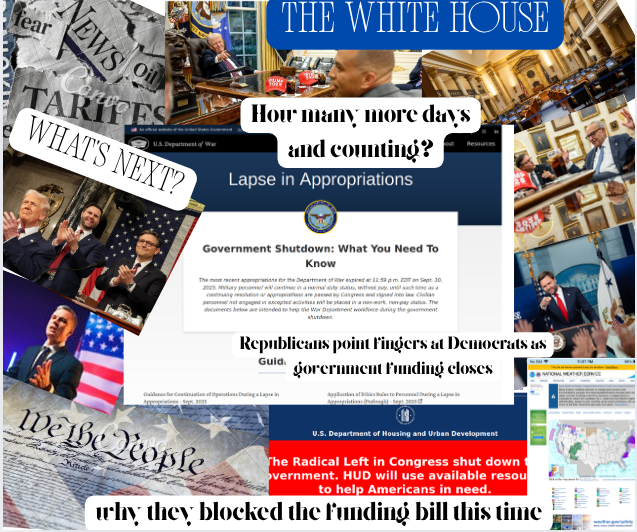
As of Nov. 6, 2025, the U.S. government has been shut down for over 4 weeks and counting starting on Oct.1. Here is what the citizens should know:
Day 1: The shutdown began at midnight, resulting from Congress’s failure to reach a balanced budget agreement. Republicans and Democrats pointed fingers at each other due to differences of opinion regarding healthcare subsidies. Researchers estimate that this crisis will cost $15 billion weekly.
About 1.4 million Federal workers will not get paid or go to work, many U.S. government services are temporarily suspended, citizens’ plane flights and trips are canceled, educational factors including student loans are impacted and most workers might have to take on a second job.
The Republicans and Democrats have continued to appear no closer to an agreement throughout the weeks. According to the facts from News POLITICO, 69% of Democrats say the shutdown is a “major problem,” expressing more concern than the 59% of Independents and the 37% of Republicans. Republicans want to leverage the Grand Old Party’s (GOP’s) need for bipartisan support.
Day 2: Oct. 2, 2025. The federal government is in a solid shutdown. There are whispers and hints on BBC.com news that the Trump administration is starting to let thousands of federal workers go in order to create a smaller, more efficient government.
“I think that we really need to collaborate better and get to a point where more than just what we think is working and actually effective,” Social Science teacher Anna Driver said.
As people have seen, this shutdown will cause a lot of issues and disturbances in the United States. Some of these include federal workers missing their first full paycheck and military families needing to rely on food banks and other organizations to help pay bills and obtain other necessities. One of these groups is the.
In addition to this, npr.org reported that state agencies would not have the funds to reimburse schools, resulting in free and low-cost meals not being provided to students. In some areas, national parks are being closed, people are losing food assistance with the Supplemental Nutrition Assistance Program (SNAP), and loans are being turned over.
Moreover, “When you shut down the government, bad things happen, and the longer the government is shut down, the more bad things will happen,” said Federal Fiscal Policy Team member Devin O’Connor on NPR.org news.
This is the 18th government shutdown in the history of the United States. When we passed Day 22, Oct. 22, 2025, we officially entered the third-longest funding lapse in the books.
“I feel like they need to both listen and come up with a better solution to the problem right now; the longer it goes, the more people are going to be affected,” Driver said.
Week 3: The Senate still fails to advance the GOP bill that is needed to pay federal workers. The House has been out on leave since September 19, with no plans of return until the shutdown is resolved.
The Supreme Court is expected to run out of funding. The Judicial branch is scheduled to run out of money for full operations on Oct. 20. Lastly, House Speaker Mike Johnson canceled voting on the following dates: Oct. 7-10 and Oct.14-17, according to CBS News.
Week 4: The GOP expected Democrats to crack on the shutdown; it turns out that the Democrats have only hardened their position, not relenting on anything of the sort. Now, for the 12th time, Senate Democrats have closed the Republican Party’s Government funding legislation for the fourth week. Not one senator has begun to switch their place or voting decision.
Week 5: The Senate has failed to make the next step for a Republican-backed funding bill to end this government shutdown for the 13th time. The pressure is continuing to rise on both political parties who are unwilling to back down. The Government workers finally say it is their time to take a clean step forward and end the shutdown.
The Federal employees and many more have officially missed their first full paycheck as of Oct. 27, 2025.
According to CBS news, Senate Majority Leader John Thune said “Despite the outcome, lawmakers from both parties have hinted at emerging deals to end the stalemate.”
However, no deal has been reached and public is dealing with the consequences. On Nov. 1, the Department of Agriculture stopped funding SNAP benefits for people in low-income jobs needing assistance to pay for basic necessities such as food.
In accordance with CBS News, 25 states are suing the Trump Administration with SNAP over the food cuts because it is a mandatory and required entitlement program.
Finally, people who have health issues, instability, and need money loans are really starting to worry about their families and others.
On the contrary, this shutdown will have different impacts and problems that will show up in the future. This could mean that the government may not have enough money stored to undertake projects and new loans.
Moreover, some small businesses could be put on hold due to funding, and a group of national parks will be closed. Additionally, educational grants as well as other resources could be cut or no longer available.
The Government Shutdown has been a long, hard, and unpredictable journey so far. However, the Government does see a point where both the Republicans and the Democrats can come together, to make a compromisable agreement and continue to run the government as it should be run, in unison.