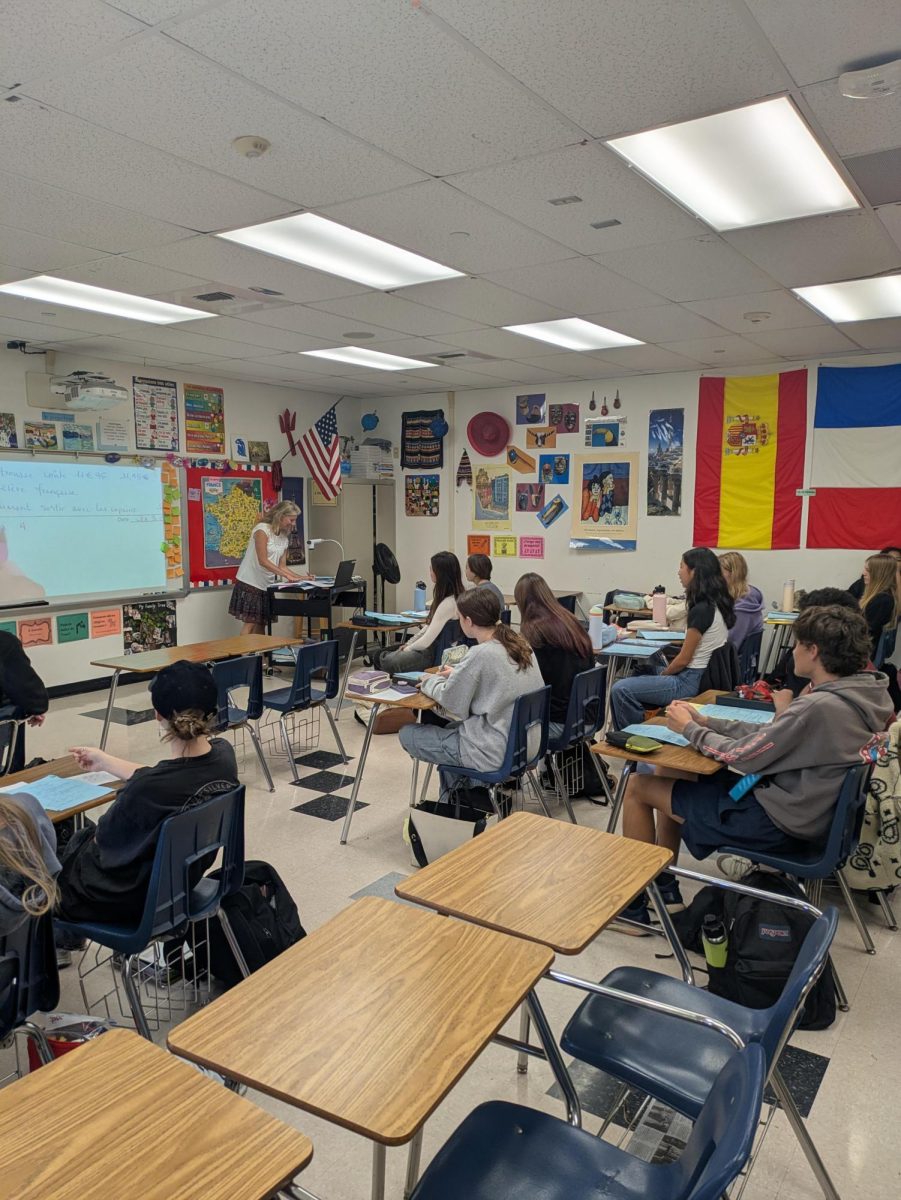
Each day, students step into Amy Byrne’s French classroom and enter a space filled with learning and consistency where students from many grade levels come together to focus on communication, French culture and the day’s lesson. The space is decorated with French posters, student work and reminders that learning a new language takes patience and practice.
Byrne, who has taught French to students for over a decade, describes her class as “pretty interactive; students sit in teams so the whole point is to talk with your partner.”
French I students begin with introductions, simple sentence structures, projects and everyday phrases they can use right away. Even in these early stages, the class stays active as students try speaking French with one another and listen to new vocabulary during activities.
As students move into later levels, the curriculum expands to more detailed grammar and longer readings. Discussions become more common, and cultural activities help students learn about life in French-speaking places. They build on what they learned in earlier years and start to understand more of the language when they hear it spoken. Many assignments give students the chance to practice talking about their own experiences in French, which helps them feel more confident.
Sophomore Adrien Perry, a French II student in Byrne’s class, said the course “is very engaging, [and] Madame Byrne is very patient and you can tell she cares a lot about her students.” Students often work with partners or in small groups, which makes practicing the language feel less intimidating.
Even though each level has different goals, the overall atmosphere stays the same. Asking questions is encouraged whether a student is brand new to the language or has been learning for years. Mistakes are treated as part of learning, and students are reminded that progress is what matters.
Students grow both in their French skills and in their confidence as learners in Byrne’s class. Many find that the class teaches them how to stick with challenges instead of avoiding them. For a lot of students, Madame Byrne’s classroom becomes a space they look back on with appreciation, knowing how much they learned and how far they came.